One mentee's ad costs kept climbing while leads kept shrinking. Here's the fix — and the 12 lead sources every coaching business should be running.
"My ads are running… but leads are hardly coming. And whatever leads are coming are becoming more expensive."
One of my mentees told me this. She was frustrated — and she had every reason to be. Money going out every day, cost per lead climbing every week, and a calendar that wasn't filling up the way it used to.
I told her something simple, and I want to tell you the same thing:
Your coaching business cannot depend on just one source of leads. You need multiple sources — both organic and inorganic.
The mistake almost every coach makes
Most coaches pick a side. They either go all-in on ads, or they go all-in on organic content, and they treat that one channel as "their marketing."
Here's what that looks like when it breaks:
- Ad costs spike every Diwali, Christmas, and New Year — every year, like clockwork — because every business is bidding for the same audience at the same time.
- Your account gets flagged, your campaign gets paused, your ad manager goes on leave, or the algorithm just decides your cost per lead doubles this month.
- Meta changes its policy, iOS changes tracking, or your niche suddenly gets more competitive — and none of it is something you control.
If ads are your only lead source, every one of those events is a crisis. If ads are one of twelve, it's a Tuesday.
I've been there myself, struggling with leads more than once. The fix was never "spend more on the one channel." It was building more channels.
Organic vs. inorganic — you need both, not one
Inorganic means paid — Meta ads, Google ads, boosted posts. Fast, scalable, and it stops the second you stop paying.
Organic means earned — content, referrals, speaking, community. Slower to build, but it compounds, and it keeps working even in the months you don't spend a rupee.
Ads bring leads today. Organic brings leads for years.
A coaching business needs both running at the same time — not one instead of the other.
The 12 lead sources to build
Apart from Meta ads, here's what should be running, in some combination, at all times:
- Social media content — LinkedIn, Instagram, Facebook. Consistent, in the client's language, not yours.
- YouTube videos — the highest-trust format there is, and it keeps generating leads years after you post.
- Events, workshops, and webinars you host — your own room, your own audience.
- Events you attend — conferences, summits, retreats, and business meetings. Leads don't only come from content you publish; they come from rooms you walk into.
- Your book — a client-in-a-box that works while you sleep, and the single most underused lead source in the coaching industry.
- Networking — BNI and similar meetups, startup and founder communities. Structured, repeatable, relationship-based.
- Groups and communities — WhatsApp groups, Facebook groups, LinkedIn groups, and communities you're already part of. Most coaches are members and never mention what they do.
- Newsletter — a channel you own completely, with no algorithm between you and your audience.
- Speaking engagements — keynotes, TEDx, and panels. Borrowed audiences, instant authority.
- Direct and partner marketing — WhatsApp marketing, email marketing, and affiliate marketing. Direct, low-cost, and almost entirely automatable.
- Referrals — not hoped for, asked for, systematically.
- Collaborations — with other coaches, consultants, and creators whose audience already trusts them.
You don't need all twelve running at full strength from day one. You need more than one. And the sources should be different kinds — some free, some paid, some fast, some slow — so no single disruption takes out your whole pipeline.
Don't build a lead source. Build a lead system.
A lead source is one channel you happen to be using.
A lead system is a set of channels working together, bringing people to you from different directions, every single day — so that on any given morning, you have leads in the pipeline regardless of what happened to any one channel overnight.
That's the shift. Not "which channel is best" — but "how many channels are running, and do they run without me having to think about it every day?"
Leads are only step one
Building the system gets people finding you. It doesn't make them clients. The next job — the one that actually pays the bills — is turning those leads into sales conversations, and sales conversations into paying clients.
That's a separate skill, and it's where most of the coaches I work with actually lose the most revenue: not in lead generation, but in what happens on the call after the lead shows up.
But you can't have that conversation if the lead never arrives. So the system comes first.
The question to ask yourself today
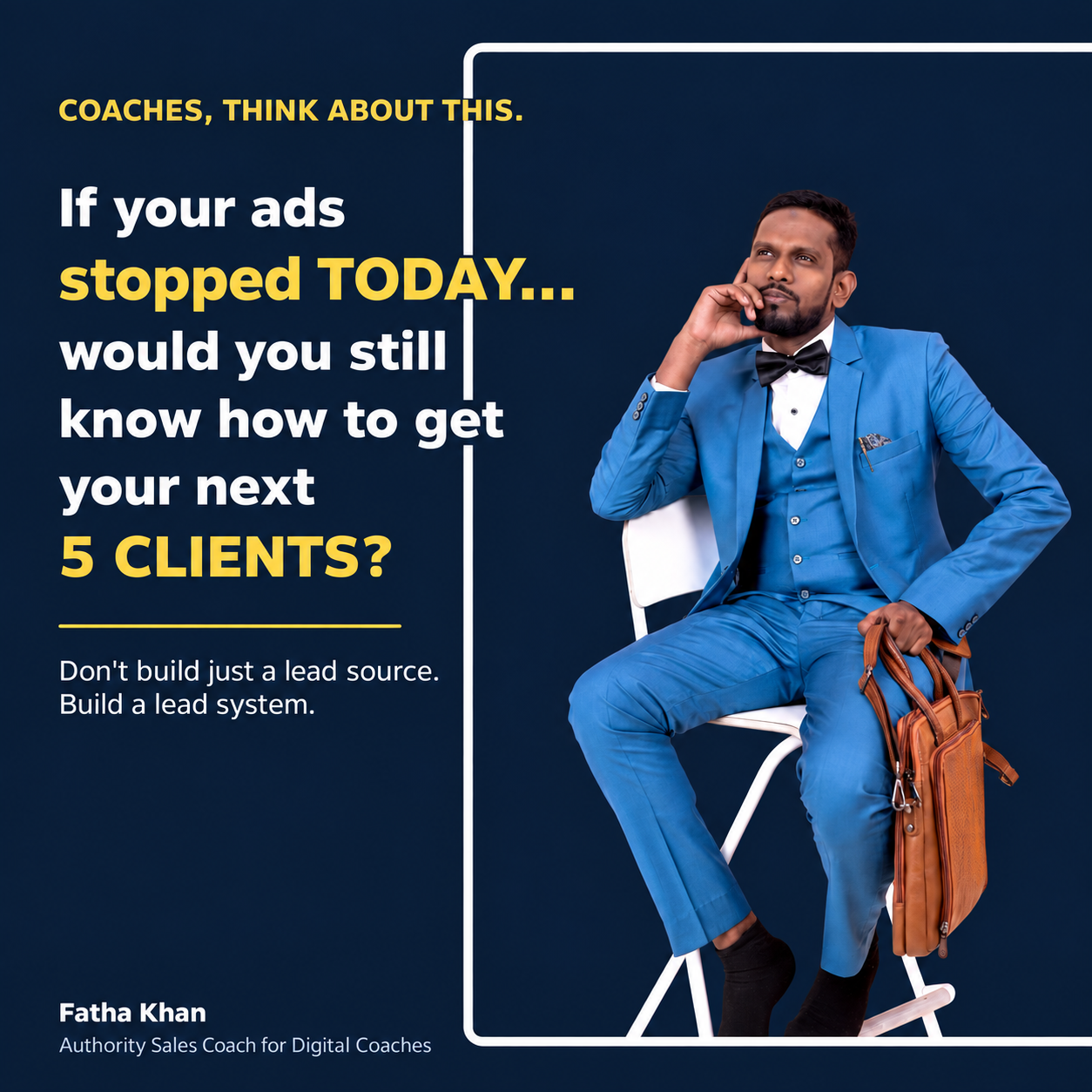
If your ads stopped today — this afternoon, no warning — would you still know how to get your next five clients?
If the honest answer is no, that's not a marketing problem. That's a dependency problem. And it's fixable, one channel at a time, starting with whichever of the twelve above you're not using yet.
Your turn
Of the 12 sources above, how many are you actually running right now? Count them. If the number is one, that's this month's project.
Fatha Khan is a Sales & Communication Coach, founder of Authority Influence Academy, 3x TEDx speaker and author. He helps coaches build authority and income through the Write · Speak · Sell system.